The Hebrew alphabet: a practical guide to 22 letters
Learn the Hebrew alphabet in a useful order: letter shapes, reading direction, vowel marks and five final forms, with a simple practice plan.
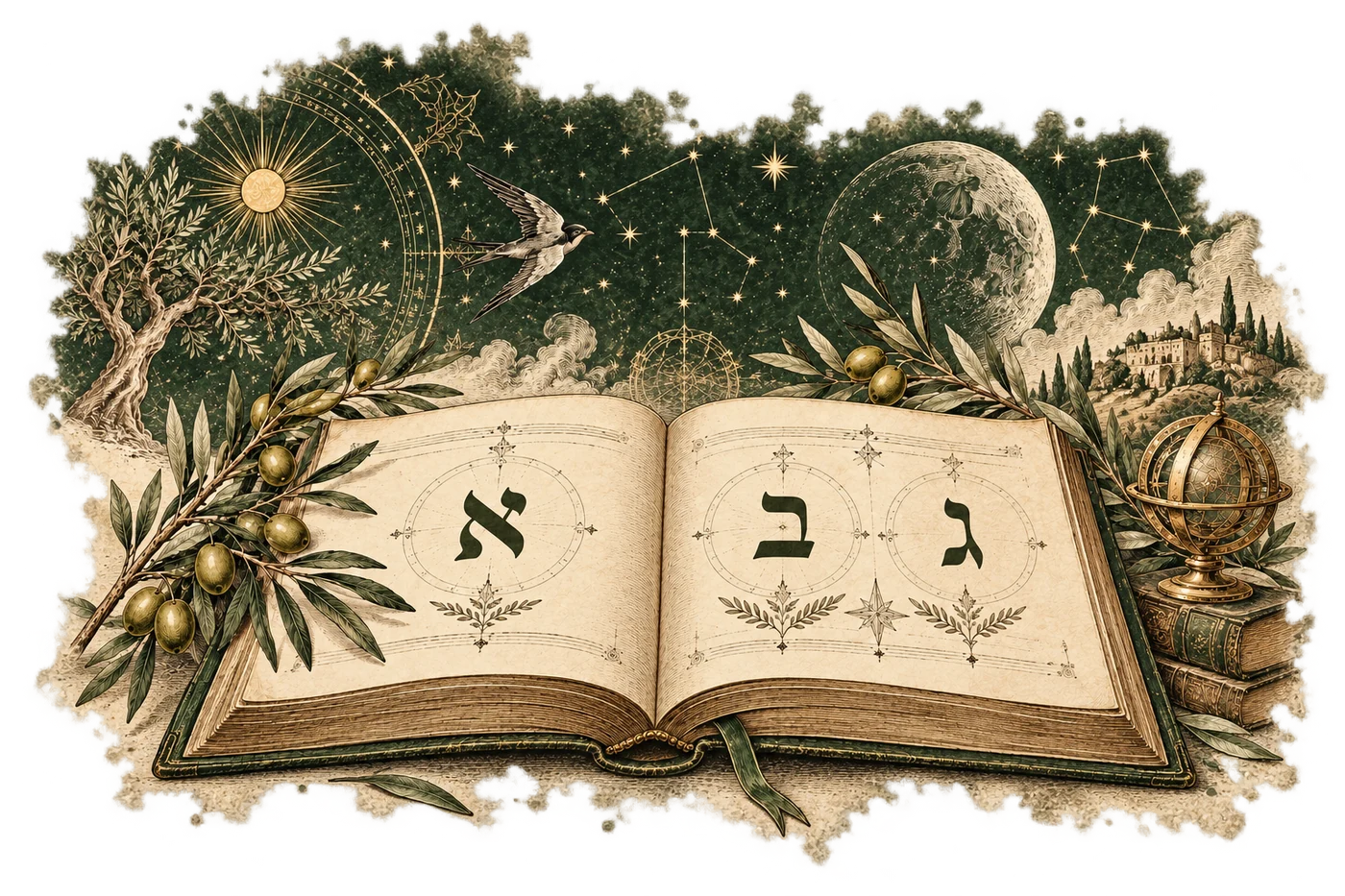
Start with 22 letters and a reading direction
The Hebrew alphabet has 22 basic letters. Hebrew words are read from right to left, and five letters have special forms at the end of a word. Those final forms are variations of existing letters. Once you recognize the basic set, the final forms and the marks that guide pronunciation, a page stops looking like an undivided pattern and begins to reveal individual words.
Begin by locating the right edge of a short Hebrew word. In שלום, usually read shalom, the first letter is ש on the right. Move through ל and ו to the final ם on the left. Read the letters in that order, even when an English explanation or a numerical calculation is written beside them. Mixed writing directions can make an otherwise simple example surprisingly hard to follow.
Source notes: Chabad · The Hebrew Alphabet · Unicode 17 · Hebrew script, section 9.1
Learn the order without rushing the sounds
The alphabet runs from Aleph to Tav. The sequence below uses familiar English spellings of the letter names; other books may write Bet as Beit, Chet as Het, or Qof as Kuf. These differences in transliteration do not create additional Hebrew letters. Keep the printed Hebrew character as your main reference when two charts use different English labels.
Learning the order is useful for finding a word in a dictionary and understanding ordinal gematria. Learning a sound is a separate task. A letter name is not always the sound you pronounce inside a word. Say the name when identifying a character, then use a teacher or reliable recording to hear that character in a complete word.
| Letter | Name | Position |
|---|---|---|
| א | Aleph | 1 |
| ב | Bet | 2 |
| ג | Gimel | 3 |
| ד | Dalet | 4 |
| ה | He | 5 |
| ו | Vav | 6 |
| ז | Zayin | 7 |
| ח | Chet | 8 |
| ט | Tet | 9 |
| י | Yod | 10 |
| כ | Kaf | 11 |
| ל | Lamed | 12 |
| מ | Mem | 13 |
| נ | Nun | 14 |
| ס | Samekh | 15 |
| ע | Ayin | 16 |
| פ | Pe | 17 |
| צ | Tsadi | 18 |
| ק | Qof | 19 |
| ר | Resh | 20 |
| ש | Shin | 21 |
| ת | Tav | 22 |
Source notes: Chabad · The Hebrew Alphabet
Give similar shapes their own attention
Several early mistakes come from treating similar silhouettes as identical. Compare ד with ר, ב with כ, and ה with ח in the same font. Look at corners, openings and small projecting strokes. Write each pair on a card with a real word underneath. A detail that seems tiny in isolation becomes easier to remember when it helps you recognize a word you already know.
Avoid memorizing one decorative drawing as the only acceptable shape. Book typefaces differ, just as Latin typefaces do. Start with a clear printed alphabet and compare it with another printed source after a few days. The aim is to identify a letter across normal variations, while remaining attentive to distinctions that change the letter itself.
Notice the marks that change a reading
The basic script is built around consonantal letters. Vowel points, often called nikkud, can be added around them to make a reading explicit. Some letters also help represent vowels in ordinary spelling. A beginner therefore needs more than a consonant chart, but does not need to master every grammatical rule before reading a short pointed word.
Dots can do different jobs. The dot inside בּ distinguishes a b reading from the v reading of ב in Modern Hebrew. A dot on the right of שׁ marks shin, while a dot on the left of שׂ marks sin. These are pronunciation marks, rather than three new alphabet positions. Ask which reading tradition your learning material follows, because pronunciation differs between communities.
Source notes: Chabad · The Hebrew Alphabet · Unicode 17 · Hebrew script, section 9.1
Recognize final forms and different scripts
The five ordinary and final pairs are כ/ך, מ/ם, נ/ן, פ/ף and צ/ץ. In שלום, the last character is final Mem, ם. You still count it as Mem when identifying the word. Practice each pair together so that the final shape becomes familiar as a position in a word, rather than a separate item to guess.
Printed block letters and handwritten Hebrew can look quite different. Learn one style securely before expecting fluency in another. Hebrew handwriting is commonly called cursive, but its letters are generally unconnected; you do not need to join them as in English handwriting. Recognizing handwriting is useful for family notes, while clear block print is usually the most helpful first step for reading study material.
Source notes: Chabad · The Hebrew Alphabet · Unicode 17 · Hebrew script, section 9.1
Build a small practice you can repeat
Use five minutes for recognition, five for listening and five for reading. First identify four letters in changing order. Then hear a short word containing them. Finally point to each letter as you read the whole word. Review yesterday’s letters before adding new ones. Accuracy on a small set provides a better foundation than finishing an alphabet chart without remembering its shapes.
Keep a record of exactly what confused you: direction, a letter pair, a final form or a vowel mark. Those are different problems with different remedies. Once you can read a few familiar words, return to their meanings and contexts. Alphabet knowledge becomes more durable when it gives you access to a greeting, a family name or a passage you actually want to understand.