An introduction to Sefer Yetzirah: letters, numbers and a world of relationships
Read Sefer Yetzirah with a clear starting point: its letter groups, symbolic correspondences, distinct versions and a careful approach to study.
A compact text of symbolic relationships
Sefer Yetzirah, commonly called the Book of Formation or Book of Creation, is a Jewish text that explores creation through numbers, Hebrew letters and structured correspondences. Read it as a text with a particular vocabulary and textual history. Its letter groupings can provide an entry point, but a modern personality chart is already an interpretation of the material rather than a transparent copy of the text.
A good first study asks what a passage actually places in relationship. Which letters are named? Which natural elements, times or human faculties appear beside them? Write those details down before supplying a meaning. The text’s compressed style invites interpretation, but the compression also makes it easy to import an explanation that the passage itself never states.
Source notes: Sefer Yetzirah · Gra version, chapter 3 · Sefer Yetzirah · Gra version, chapter 4 · Sefer Yetzirah · Gra version, chapter 5
Begin with Aleph, Mem and Shin
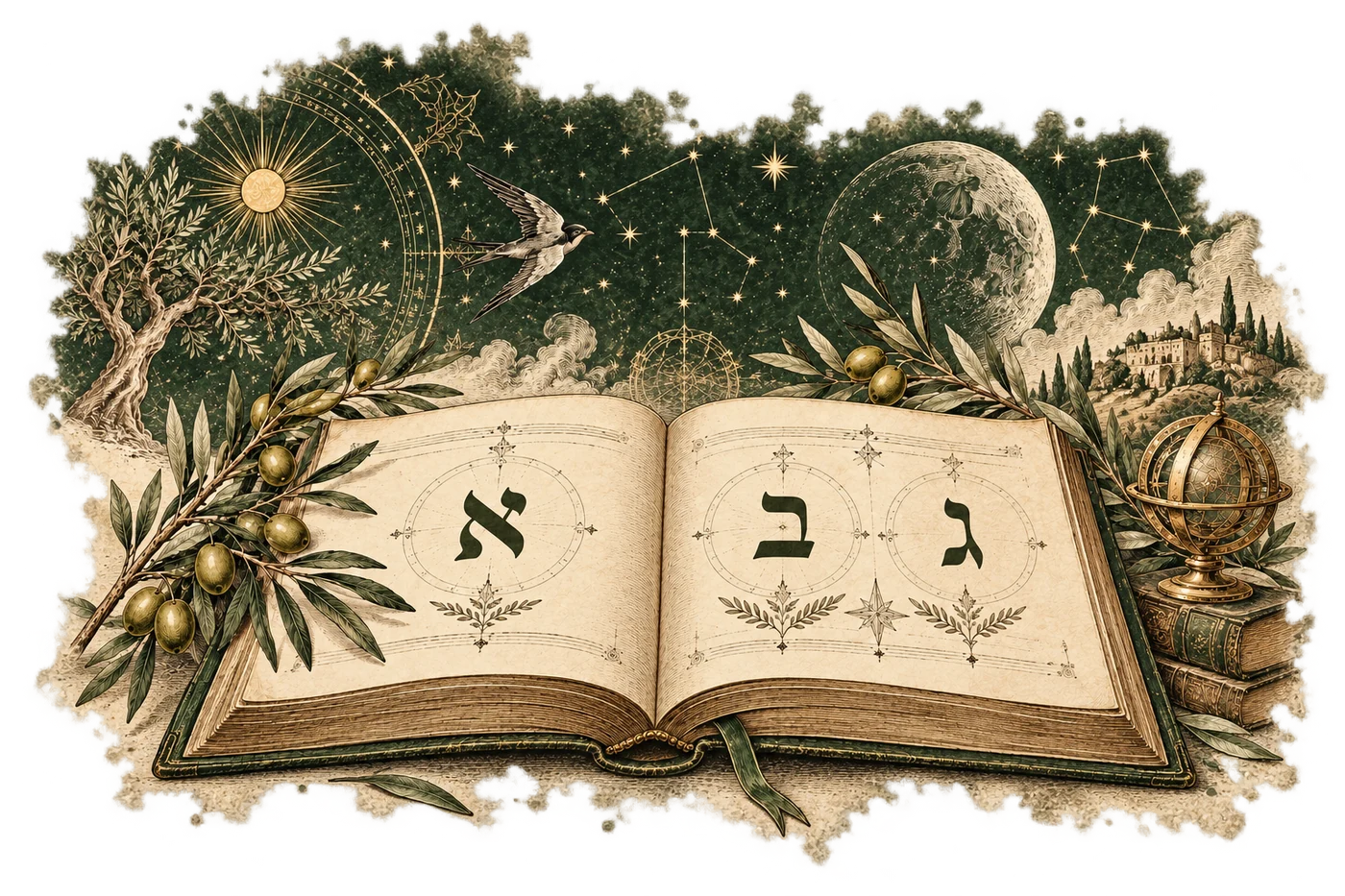
Chapter 3 of the Gra version discusses the three mother letters, א, מ and ש: Aleph, Mem and Shin. It places them in relationship with air, water and fire. Rather than reading each correspondence as an isolated label, observe how a small set structures several parts of the discussion. The repeated pattern is part of what gives the chapter its distinctive way of describing a world.
For a first notebook page, draw three columns headed with the Hebrew letters. Add only what your selected passage explicitly associates with them. Leave a separate space for a translation choice or a commentator’s explanation. This slows the temptation to combine several modern charts into one system and helps you see where an association came from.
Source notes: Sefer Yetzirah · Gra version, chapter 3
The seven doubles form a second group
The Gra version’s chapter 4 names seven double letters: ב, ג, ד, כ, פ, ר and ת. It discusses contrasting qualities and sets of seven. The word double belongs to the text’s classification of letters. It should not be treated as a statement that every contemporary Hebrew pronunciation preserves all the same paired sounds described in the passage.
This is an especially useful place to keep language learning and textual study connected but distinct. A Modern Hebrew lesson tells you how a speaker reads a letter now. Sefer Yetzirah arranges letters within its symbolic scheme. You can investigate both questions without requiring the modern lesson to reproduce the whole scheme or the symbolic text to function as a modern pronunciation manual.
Source notes: Sefer Yetzirah · Gra version, chapter 4
The twelve simple letters connect with the year
Chapter 5 of the Gra version presents twelve simple letters, also translated as elementals: ה, ו, ז, ח, ט, י, ל, נ, ס, ע, צ and ק. It brings them into relation with twelve months and zodiacal signs. In its first set of individual pairings, Heh is associated with speech, Aries and Nisan. This is a traceable example of the text’s pattern.
Keep a correspondence separate from a claim about a person. Being born in Nisan gives you a calendar fact; finding a Nisan association in a named version gives you a textual fact. Writing a question about speech is a contemporary interpretive exercise. Those three steps can be useful together when each remains visible, and misleading when the last step is presented as an ancient psychological diagnosis.
Source notes: Sefer Yetzirah · Gra version, chapter 5
Name the version before comparing a chart
Sefer Yetzirah exists in distinct textual versions. Sefaria provides a Gra version and another text titled Sefer Yetzirah, which you can read side by side. Their arrangements and some correspondences differ. A chart that gives only the book’s name leaves a reader without enough information to locate its pairings or understand why another chart supplies a different faculty.
For example, the Gra version’s Heh and Nisan pairing names the right foot, while the other chapter 5 pairing names the right hand. Its opening list also arranges the faculties differently. These differences are reasons to identify the version, rather than quietly selecting whichever detail suits a reading. Mazalogy states its use of the Gra version. When comparing another source, preserve its own wording and note the difference instead of blending the two.
Source notes: Sefer Yetzirah · Gra version, chapter 5 · Sefer Yetzirah · Another version, chapter 5
Study a short passage with its layers visible
Start with a chapter rather than an entire symbolic system. Record the version, the passage reference, the Hebrew terms and the translation you are using. Next write a literal summary in your own words. Then read a named commentary and identify what it adds. Traditional attribution, historical dating and the identity of an editor are different questions; contested answers should not be presented as settled facts.
Finish with one contemporary question and label it as your own. A passage concerning speech might invite you to notice how you listen during a difficult conversation. You need not claim that the book prescribed that exercise. Careful study makes room for religious meaning, language and interpretation while protecting the boundary between an ancient passage and a present-day application.